Bluetooth HDT raises the new Bluetooth LE radio link’s maximum rate to 7.5 Mbit/s. The Bluetooth SIG announced its adoption on 4 November 2026, opening up more capacity for wireless audio. Getting that capability into headphones people can buy will still require compatible implementations: the SIG points to 2027 for the first premium audio products with HDT.
More radio capacity, rather than a new codec
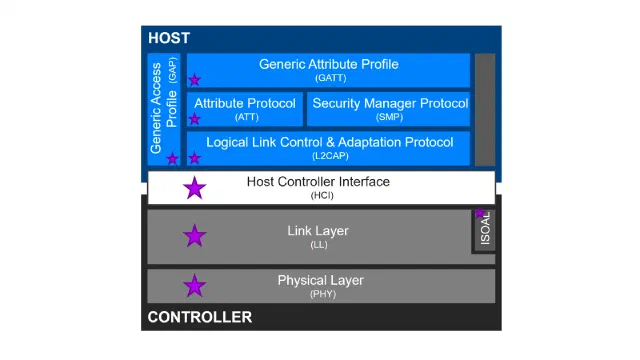
HDT stands for High Data Throughput. It changes the physical layer, which determines how data travels over the radio link, and continues to use the 2.4 GHz band. A codec handles how audio is represented and, where applicable, compressed. More transmission capacity gives audio data more room; it does not determine which audio data a product sends.
The relevant comparison is with the LE 2M PHY’s 2 Mbit/s: the new maximum is 3.75 times that rate. The radio rate is not the available audio bitrate, since protocol information also needs space and retransmissions may be necessary.
Consider the arithmetic for two PCM channels at 96 kHz and 24 bits: 96,000 × 24 × 2 = 4.608 Mbit/s for the samples alone. That is a theoretical data requirement, not proof that every HDT device will carry that format losslessly. Our lossless audio explainer looks more closely at what preserving the samples means.
What devices will need
HDT is an optional Bluetooth Core 7.0 feature. Even within HDT implementations, the 6 and 7.5 Mbit/s modes are optional, so a Bluetooth version number cannot tell you which rates a product supports. Both the phone and the headphones will need the required capabilities, along with suitable software and an appropriate audio path.
Compatibility with earlier LE links allows communication with older devices; it does not give those devices the new capabilities. A software update for headphones already on sale should therefore not be assumed.
As products arrive, look for explicit HDT support, the audio formats actually carried and the operating conditions in their documentation. More link capacity can remove a constraint. Recording quality and headphone performance still need to be assessed on their own merits.
Sources
- Bluetooth High Data Throughput: adoption announcement ↗ — Bluetooth SIG · accessed 2026-11-09
- Bluetooth High Data Throughput technical overview ↗ — Bluetooth SIG · accessed 2026-11-09
- Bluetooth Core 7.0 feature overview ↗ — Bluetooth SIG · accessed 2026-11-09