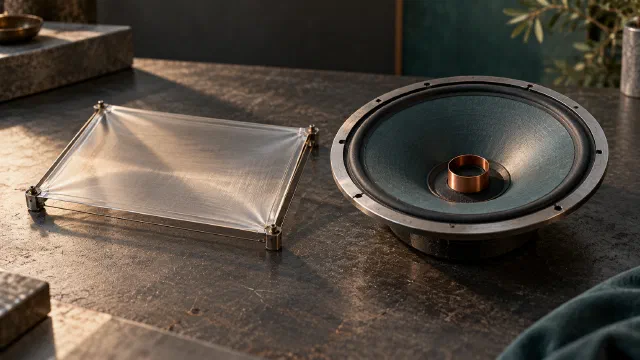
On a headphone spec sheet, “planar” and “dynamic” describe how the driver moves its diaphragm. To understand what this means for listening, you also need to consider the acoustic design, fit and source: two models in the same family can behave very differently.
How does movement happen?
In a dynamic driver, a moving coil wound around a former is attached to the diaphragm: current displaces it and the diaphragm follows. The force is concentrated around the coil, and the rest of the membrane moves as a consequence.
In a planar magnetic design the conductor is distributed across a thin membrane suspended in a magnetic field generated by rows of magnets. Depending on the design, magnets sit on one or both sides of the diaphragm. The force acts over a broader area, which changes how the membrane deforms ( Audeze ).
What actually changes when listening?
Listening performance cannot be inferred from the principle alone. The construction principle influences efficiency, impedance and membrane behaviour, but the final result depends on the whole: earcups, pads, seal on the head, damping, internal volume and coupling with the ear.
Two practical consequences:
- Efficiency varies widely. Required voltage and current depend on sensitivity, impedance and target level, not simply on the planar or dynamic label. See impedance and sensitivity .
- Weight cannot be deduced from technology. Magnets contribute mass; headband design and weight distribution also affect comfort. Assess the individual model.
Open- or closed-back construction is a separate design choice from driver type. Both planar and dynamic headphones can use either construction.
What specifications say, and what they do not
Shure points out that headphone parameters must be read together and with their units ( Shure ). A good datasheet reports impedance, sensitivity with its reference unit (dB/mW or dB/V), frequency response with tolerance, and distortion with the measurement condition.
| Datum | What it says | What it does not say |
|---|---|---|
| Impedance | electrical load seen by the amplifier | sound quality |
| Sensitivity | acoustic level for a given drive | how “good” it sounds |
| Frequency response | level variation with frequency under the stated conditions | individual response at your ear without comparable measurement conditions |
| Distortion | behaviour at a given level | behaviour at other levels or under different test conditions |
For a useful comparison, check the method too: measurement level, coupling and test rig. Without comparable conditions, the figures can mislead.
Choosing without auditioning ten models
- Start from real use: needed isolation, hours of listening, available source.
- Check that the source can drive them, not just that the plug fits.
- Look for independent measurements with a stated method, not only manufacturer curves.
- Try the fit: stated mass, headband pressure and pad shape do not fully describe comfort on your head.
When choosing headphones, use driver technology to understand the design, then return to the actual model: comfort, response, distortion and source compatibility. Independent measurements with stated conditions are useful when a specification sheet leaves those questions open.
Sources
- Planar magnetic technology ↗ — Audeze · accessed 2026-11-01
- Earphone and headphone specifications ↗ — Shure · accessed 2026-11-01